

JavaScript frameworks and libraries streamline web design and development, enhancing efficiency, performance, and scalability for developers building modern, dynamic, and interactive applications.
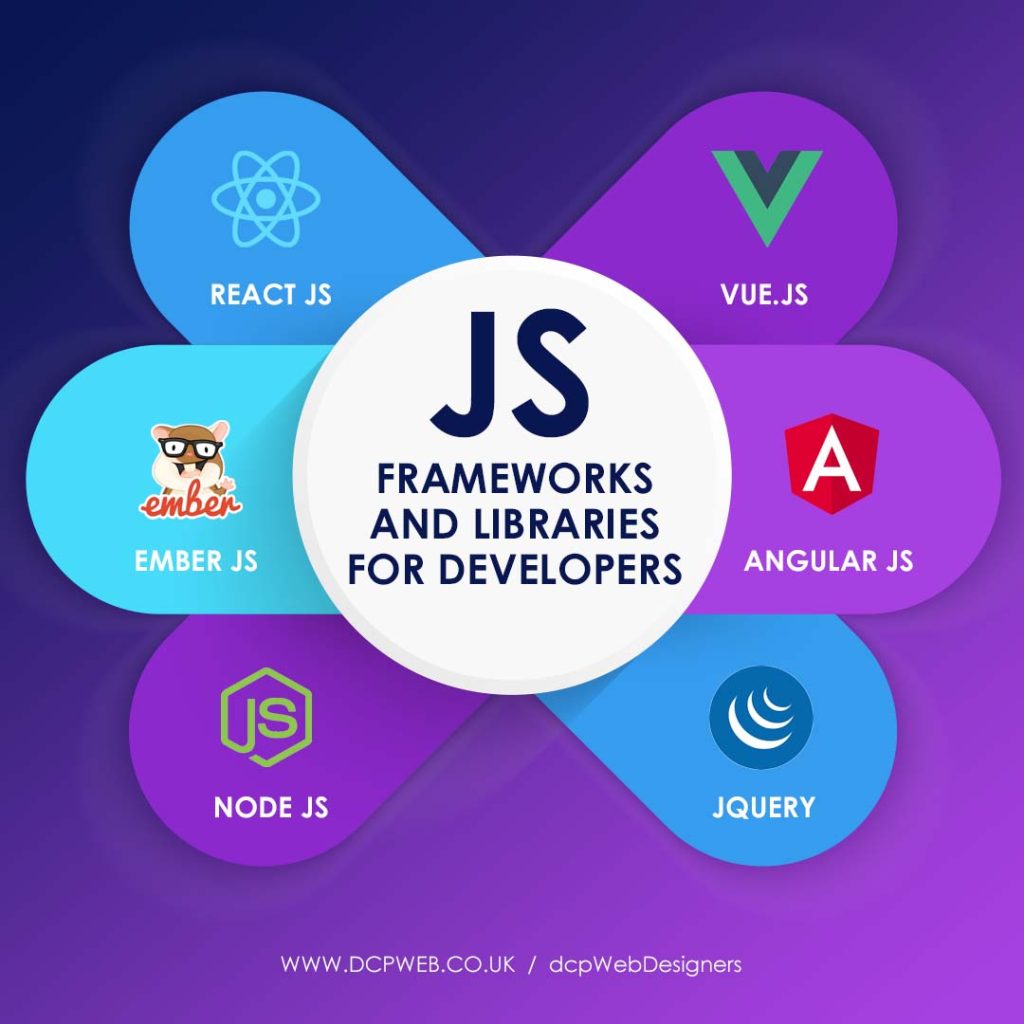
In this infographic post, we will review the top 6 popular JavaScript frameworks and libraries.
React JS
Understanding React JS: What It Is and Why You Should Use It.
What Is React JS?
React JS is an open-source JavaScript library developed by Facebook for building user interfaces, particularly single-page applications where dynamic content updates without reloading the page. React follows a component-based architecture, allowing developers to create reusable UI components that manage their own state.
React is primarily used for front-end development, enabling web developers to build interactive, high-performance applications. Many large-scale companies, including Facebook, Instagram, Airbnb, and Netflix, use React for its efficiency in handling complex user interfaces.
What Is React JS Used For?
React is commonly used for:
- Single-Page Applications (SPAs): React allows for the seamless rendering of content dynamically without requiring full-page reloads.
- Web Applications: Many companies build their websites with React to ensure fast rendering, responsive design, and smooth user experience.
- Mobile Applications: With React Native, developers can use React JS to create mobile applications for iOS and Android from a single codebase.
- E-commerce Websites: React helps in building scalable, interactive shopping platforms with features like real-time updates, filters, and smooth navigation.
- Dashboards and Data Visualisation: React efficiently renders data-heavy applications, making it an excellent choice for analytics dashboards and business intelligence tools.
- Social Media Platforms: Many social media applications use React to manage real-time updates, chat features, and user interactions.
Benefits of Using React JS
Component-Based Architecture
React follows a modular, component-based structure, making it easy to reuse and manage code. Developers can create independent UI components and combine them to build complex interfaces without redundancy.Virtual DOM for Faster Rendering
Unlike traditional approaches that update the actual DOM directly, React uses a Virtual DOM to optimise rendering. It updates only the changed components instead of reloading the entire page, improving performance significantly.Fast and Efficient Development
React’s declarative syntax and reusable components speed up development time. Developers can build features quickly while maintaining code simplicity and clarity.Strong Community and Ecosystem
React has a vast community of developers, extensive documentation, and numerous third-party libraries, ensuring continuous improvements, support, and a wealth of pre-built solutions.SEO-Friendly
React applications can be optimised for search engines using Server-Side Rendering (SSR) with Next.js. This makes React a good choice for businesses looking to enhance their website’s visibility on search engines.Cross-Platform Development with React Native
React’s ecosystem includes React Native, which allows developers to build mobile applications using the same JavaScript codebase, reducing development time and costs.Flexibility and Easy Integration
React can be easily integrated with other frameworks and libraries like Redux for state management or GraphQL for data fetching, providing flexibility in building feature-rich applications.Backward Compatibility and Long-Term Support
React ensures stability by maintaining backward compatibility, allowing developers to upgrade applications without breaking functionality. Facebook’s ongoing support ensures React remains relevant and updated.
React JS is a powerful, flexible, and efficient library for front-end development. Its component-based structure, Virtual DOM, and strong community support make it an ideal choice for building modern web and mobile applications.
Whether you’re creating an e-commerce site, a data dashboard, or a social media platform, React offers the tools to build scalable and high-performing user interfaces.
Vue JS
A Powerful JavaScript Framework for Modern Web Development.
What Is Vue JS?
Vue JS is an open-source JavaScript framework used for building user interfaces and single-page applications (SPAs). Developed by Evan You in 2014, Vue is designed to be lightweight, flexible, and easy to integrate into projects. It follows a component-based architecture similar to React but offers a simpler learning curve, making it a popular choice among developers of all experience levels.
Vue is widely used for front-end development and is known for its ease of use, reactive data binding, and seamless integration with existing applications. Many businesses and developers prefer Vue due to its efficiency in creating dynamic, high-performing web applications.
What Is Vue JS Used For?
Vue JS is used in various types of web applications, including:
- Single-Page Applications (SPAs): Vue enables the development of SPAs that load content dynamically without requiring full-page reloads.
- User Interfaces (UIs): It is used to build interactive UI components that enhance user experience.
- E-commerce Websites: Vue helps in creating highly responsive and engaging e-commerce platforms.
- Real-Time Applications: Applications that require real-time updates, such as chat applications and dashboards, benefit from Vue’s reactive data binding.
- Progressive Web Applications (PWAs): Vue can be used to develop fast-loading PWAs with offline capabilities.
- Enterprise-Level Applications: Many companies use Vue for large-scale projects due to its scalability and flexibility.
Benefits of Using Vue JS
Easy Learning Curve
Vue is designed to be beginner-friendly. Developers with basic knowledge of HTML, CSS, and JavaScript can quickly grasp Vue’s core concepts and start building applications.Lightweight and Fast
Vue’s lightweight nature (around 20KB in size) ensures faster loading times and improved application performance. This makes it ideal for projects that require speed and efficiency.Reactive Data Binding
Vue’s two-way data binding allows automatic synchronization between the model and the view, reducing the need for manual DOM manipulation. This leads to cleaner and more efficient code.Component-Based Architecture
Like React, Vue follows a component-based architecture, making it easy to create reusable and maintainable components. This modular approach enhances development efficiency and reduces redundancy.Flexibility and Integration
Vue can be easily integrated into existing projects without requiring a complete overhaul. It can be used alongside other libraries or frameworks, making it a flexible choice for developers.Virtual DOM for Improved Performance
Vue uses a Virtual DOM to efficiently update only the necessary parts of the user interface, improving application speed and performance.Strong Community and Ecosystem
Vue has an active and supportive community, extensive documentation, and a growing ecosystem of tools, including Vue Router for navigation and Vuex for state management.SEO-Friendly
Vue supports Server-Side Rendering (SSR) with tools like Nuxt.js, making it an excellent choice for SEO-optimised applications.Well-Suited for Small and Large-Scale Applications
Vue is flexible enough to be used for both small projects and large enterprise applications, ensuring scalability as businesses grow.
Vue JS is a powerful, flexible, and easy-to-learn JavaScript framework that simplifies front-end development. Its component-based architecture, lightweight nature, and strong community support make it an excellent choice for building modern web applications.
Whether you’re developing a small business website, a real-time dashboard, or an enterprise-level application, Vue JS provides the tools and efficiency needed to create high-performance applications.
Ember JS
A Robust JavaScript Framework for Scalable Web Applications
What Is Ember JS?
Ember JS is an open-source JavaScript framework used for building ambitious web applications. Originally released in 2011, Ember JS follows the Model-View-ViewModel (MVVM) architectural pattern, offering a structured approach to building scalable applications. It is designed to provide everything developers need to create feature-rich single-page applications (SPAs) while maintaining clean, maintainable code.
Ember JS is particularly well-suited for large-scale web applications that require strong conventions, reusable components, and seamless user experiences. Some well-known companies using Ember include LinkedIn, Netflix, and Apple Music.
What Is Ember JS Used For?
Ember JS is commonly used for:
- Single-Page Applications (SPAs): Ember provides a structured way to build SPAs that dynamically update content without requiring a page reload.
- Enterprise-Grade Applications: Large-scale applications with complex data flows benefit from Ember’s conventions and scalable architecture.
- Web-Based Dashboards: Data-heavy applications, such as analytics and reporting tools, are built efficiently using Ember’s data layer and reusable components.
- Content Management Systems (CMS): Ember is often used in custom CMS development to create a smooth and interactive user experience.
- E-Commerce Platforms: Online shopping sites that require fast performance and a structured development approach can leverage Ember’s capabilities.
- Progressive Web Applications (PWAs): Ember can be used to build modern web applications with offline capabilities.
Benefits of Using Ember JS
Convention Over Configuration
Ember JS follows a convention-over-configuration approach, meaning developers spend less time deciding how to structure their projects and more time building features. The framework enforces best practices by default, reducing inconsistencies in large codebases.Two-Way Data Binding
Ember provides built-in two-way data binding, allowing automatic synchronisation between the user interface and application data. This simplifies data handling and improves application responsiveness.Powerful Ember CLI
The Ember Command Line Interface (CLI) streamlines the development process by providing powerful tools for project scaffolding, testing, and asset management. It automates many common development tasks, boosting productivity.Component-Based Architecture
Ember’s component-based architecture allows developers to create reusable UI elements, improving code maintainability and modularity. Components help in building complex user interfaces efficiently.Ember Data for Handling APIs
Ember includes Ember Data, an integrated data management library that simplifies working with APIs and backend data. It provides built-in support for JSON:API, making data fetching and manipulation more efficient.Robust Routing System
Ember’s built-in routing system is one of the most advanced among JavaScript frameworks. It allows for deep linking, nested routes, and query parameters, making it ideal for applications that require complex navigation structures.Large and Active Community
Ember has a dedicated and active community, ensuring continuous updates, comprehensive documentation, and a wealth of third-party plugins to enhance functionality.Backward Compatibility and Long-Term Support
Ember prioritizes backward compatibility, ensuring that upgrades do not break existing applications. This makes it a reliable choice for long-term projects that require stability.Testing Built-In
Ember has a built-in testing framework that allows developers to write and run tests efficiently, ensuring application reliability and reducing the chances of bugs.SEO and Performance Optimization
Ember supports server-side rendering (SSR), improving SEO and initial page load times, making it a great choice for search engine-friendly applications.
Ember JS is a powerful framework for building ambitious web applications. Its structured approach, convention-based architecture, and built-in tools make it an excellent choice for developers working on scalable, data-driven applications.
Whether you’re building a complex enterprise application, a single-page app, or a feature-rich dashboard, Ember JS provides the necessary tools and stability for long-term success.
Angular JS
A Powerful Framework for Dynamic Web Applications.
What Is Angular JS?
Angular JS is an open-source JavaScript framework developed by Google to create dynamic, single-page web applications (SPAs). First released in 2010, Angular JS follows the Model-View-Controller (MVC) architecture, making it easier for developers to build scalable, maintainable applications. It allows for the development of interactive web applications by extending HTML’s capabilities and enabling two-way data binding.
Although Angular JS (version 1.x) has been succeeded by Angular (versions 2+), it remains a popular choice for legacy applications and projects that require a structured approach to development.
What Is Angular JS Used For?
Angular JS is widely used in:
- Single-Page Applications (SPAs): It enables the creation of fast, dynamic web applications that update content without reloading the page.
- Enterprise Web Applications: Large-scale business applications with complex workflows benefit from Angular JS’s structured development approach.
- E-commerce Websites: Online shopping platforms use Angular JS for dynamic filtering, product management, and smooth navigation.
- Content Management Systems (CMS): Angular JS helps in building interactive and customisable CMS solutions.
- Real-Time Applications: Applications such as chat apps, dashboards, and stock market trackers use Angular JS for real-time updates.
- Progressive Web Applications (PWAs): Angular JS is used to develop web apps that offer offline support and a native app-like experience.
Benefits of Using Angular JS
Two-Way Data Binding
One of the standout features of Angular JS is its two-way data binding, which ensures real-time synchronisation between the model and the view. When data changes in the model, the UI updates automatically, reducing the need for manual DOM manipulation.MVC Architecture
Angular JS follows the Model-View-Controller (MVC) pattern, streamlining the development process by separating concerns. This leads to better code organisation and easier maintenance.Dependency Injection (DI)
Angular JS uses a built-in dependency injection system, making it easier to manage dependencies and improve the modularity of applications. DI also enhances testing and reusability.Directives for Extending HTML
Directives in Angular JS allow developers to extend HTML functionality, creating reusable components and custom elements that improve the structure of web applications.Built-In Templates
Angular JS uses declarative templates that make it easier to build and manage dynamic views. These templates simplify development and improve readability.Robust Routing System
The framework provides a built-in routing system that enables seamless navigation between different views without requiring full-page reloads. This is essential for building SPAs.Testing-Friendly Framework
Angular JS is designed with testing in mind, offering built-in tools for unit and end-to-end testing. The framework provides features like dependency injection and mock services to simplify testing.Large Community and Google Support
As a Google-backed framework, Angular JS has extensive documentation, a large developer community, and continued support for legacy applications, making it a reliable choice.Modularity and Code Reusability
Angular JS allows developers to create modular applications, improving maintainability and reusability. The framework’s structure supports building large applications with minimal code duplication.Improved User Experience
With its ability to create dynamic and interactive user interfaces, Angular JS enhances user experience, making applications more responsive and engaging.
Angular JS is a powerful and structured framework for building dynamic web applications. Its two-way data binding, MVC architecture, and modular approach make it an excellent choice for developers looking to create scalable and maintainable web applications.
Whether you’re developing an enterprise-level project, an e-commerce site, or a real-time dashboard, Angular JS provides the necessary tools to build efficient and user-friendly applications.
Node JS
A High-Performance JavaScript Runtime for Scalable Applications.
What Is Node JS?
Node JS is an open-source, cross-platform JavaScript runtime environment built on Chrome’s V8 JavaScript engine. Released in 2009, Node JS allows developers to execute JavaScript code outside the browser, making it possible to build server-side applications using JavaScript.
Unlike traditional server-side technologies, Node JS follows an event-driven, non-blocking I/O model, which makes it highly efficient for handling multiple requests simultaneously. This makes Node JS an ideal choice for real-time applications, microservices, and scalable web applications.
What Is Node JS Used For?
Node JS is widely used in various types of applications, including:
- Web Servers and APIs: Node JS is commonly used to build RESTful APIs and backend services for web and mobile applications.
- Real-Time Applications: Applications like chat apps, live streaming platforms, and online gaming servers benefit from Node JS’s event-driven nature.
- Microservices Architecture: Node JS is widely adopted in microservices-based applications, enabling efficient modular development.
- Single-Page Applications (SPAs): Node JS helps manage SPAs by handling data updates and providing a smooth user experience.
- Internet of Things (IoT) Applications: Many IoT devices rely on Node JS for handling multiple device connections efficiently.
- E-commerce Platforms: Online marketplaces and e-commerce platforms use Node JS for high-performance data processing and scalability.
- Serverless Applications: Node JS is often used with cloud platforms like AWS Lambda for serverless computing.
- Streaming Services: Video and music streaming applications leverage Node JS’s capabilities to handle data-intensive operations.
Benefits of Using Node JS
Fast Performance with V8 Engine
Node JS runs on Google’s V8 engine, which compiles JavaScript directly into machine code, making it extremely fast. This speed advantage is particularly beneficial for data-intensive applications.Non-Blocking, Event-Driven Architecture
Unlike traditional web servers that handle requests sequentially, Node JS uses an asynchronous, non-blocking model. This means it can handle multiple requests simultaneously, improving performance and efficiency.JavaScript for Both Frontend and Backend
With Node JS, developers can use JavaScript for both client-side and server-side development, reducing the need for multiple programming languages and improving code reusability.Scalability for Large Applications
Node JS is designed to handle a high number of concurrent connections efficiently. Its event-driven architecture makes it suitable for scalable applications, such as large e-commerce websites and real-time platforms.Rich Package Ecosystem (NPM)
Node JS has a vast ecosystem of open-source libraries and modules available via the Node Package Manager (NPM). Developers can access thousands of pre-built packages to speed up development.Microservices and Serverless Compatibility
Node JS is an excellent choice for microservices architecture, enabling modular development and deployment. It also integrates well with serverless computing platforms like AWS Lambda.Cross-Platform Development
Developers can use Node JS to build cross-platform applications, including desktop apps with frameworks like Electron JS.Strong Community and Corporate Support
Node JS has a large, active community, backed by companies like Google, Microsoft, and Netflix. This ensures continuous improvements, security updates, and extensive documentation.Efficient Handling of I/O Operations
Node JS is optimised for handling I/O-heavy operations, such as file reading/writing, database interactions, and API requests, making it suitable for applications that rely on real-time data.Improved Developer Productivity
With JavaScript on both the front end and back end, developers can work more efficiently, reducing development time and improving team collaboration.
Node JS is a powerful runtime environment that enables developers to build fast, scalable, and real-time applications using JavaScript. Its event-driven, non-blocking architecture, coupled with the vast NPM ecosystem and cross-platform capabilities, makes it an excellent choice for modern web development.
Whether you’re building a high-performance API, a real-time chat application, or a microservices-based platform, Node JS provides the tools needed for efficient and scalable development.
jQuery
A Lightweight JavaScript Library for Simplified Web Development/
What Is jQuery?
jQuery is a fast, lightweight, and feature-rich JavaScript library designed to simplify client-side scripting. Released in 2006 by John Resig, jQuery provides an easy-to-use API that works across different web browsers, reducing compatibility issues. It helps developers write less code while achieving more functionality, making web development faster and more efficient.
Although modern JavaScript frameworks like React and Vue have gained popularity, jQuery remains widely used for quick scripting, animations, DOM manipulation, and AJAX calls. Many legacy applications and CMS platforms, including WordPress, still rely on jQuery for enhanced interactivity.
What Is jQuery Used For?
jQuery is commonly used for:
- DOM Manipulation: It allows developers to easily select, modify, and update elements in the HTML document.
- Event Handling: jQuery simplifies event handling, such as click, hover, and key press events, across different browsers.
- Animations and Effects: Developers can create smooth animations, fading effects, slide transitions, and more with built-in jQuery methods.
- AJAX Requests: jQuery provides easy-to-use AJAX functions for sending and receiving data from a server without refreshing the page.
- Cross-Browser Compatibility: jQuery ensures consistent functionality across multiple web browsers, eliminating common compatibility issues.
- Form Validation: Many websites use jQuery for client-side form validation before submitting data to the server.
- Simplified JavaScript Code: jQuery reduces the complexity of writing JavaScript, making it easier for beginners and experienced developers alike.
- Interactive UI Elements: jQuery powers interactive components like image sliders, modal pop-ups, dropdown menus, and tooltips.
- Integration with CMS Platforms: Many content management systems (CMS) like WordPress, Joomla, and Drupal use jQuery for enhanced frontend functionality.
- Mobile-Friendly Web Development: jQuery Mobile, an extension of jQuery, helps in building responsive, mobile-friendly applications.
Benefits of Using jQuery
Simplified JavaScript Syntax
jQuery allows developers to achieve complex tasks with minimal code. The library provides built-in functions that replace long JavaScript code with concise, readable methods.Cross-Browser Compatibility
One of jQuery’s biggest advantages is its ability to work consistently across different web browsers. It abstracts away browser inconsistencies, ensuring that code runs smoothly on Chrome, Firefox, Edge, Safari, and Internet Explorer.Fast and Lightweight
jQuery is small in size (compressed versions are less than 100KB), ensuring faster page load times and minimal impact on performance.Easy DOM Manipulation
With jQuery, developers can easily select, traverse, and manipulate HTML elements using simple selectors and methods.Built-In Effects and Animations
jQuery provides a wide range of built-in animations, such as fading, sliding, and toggling elements, reducing the need for complex CSS or JavaScript animations.Efficient AJAX Handling
jQuery simplifies AJAX requests, enabling developers to fetch and update data dynamically without requiring a page refresh.Extensive Plugin Support
Thousands of jQuery plugins are available to extend its functionality, allowing developers to add features like image sliders, date pickers, and lightboxes without writing extensive code.Strong Community and Documentation
jQuery has an active community and comprehensive documentation, making it easy for developers to find solutions and resources.Integration with Other Libraries and Frameworks
jQuery can be easily integrated with other JavaScript frameworks, making it a flexible choice for various projects.Wide Adoption in CMS Platforms
Many popular CMS platforms and themes include jQuery by default, making it an essential tool for web development.
jQuery remains a valuable tool for web developers who need a lightweight, easy-to-use JavaScript library for DOM manipulation, animations, AJAX handling, and event management.
While newer frameworks like React and Vue have gained traction, jQuery continues to be widely used in CMS platforms, legacy applications, and projects requiring quick and efficient JavaScript solutions.
Whether you are a beginner or an experienced developer, jQuery simplifies web development and enhances user experience with minimal coding effort.
Conclusion
JavaScript frameworks and libraries play a crucial role in modern web development, each offering unique advantages tailored to different project needs.
React JS and Vue JS provide component-based architectures, making UI development efficient and scalable. Ember JS and Angular JS excel in building large-scale, enterprise-level applications with strong conventions and structured development approaches.
Meanwhile, Node JS extends JavaScript to the backend, enabling high-performance, scalable server-side applications. jQuery, though older, remains valuable for simplifying DOM manipulation, animations, and AJAX requests.
Each technology serves distinct purposes, whether creating single-page applications, real-time platforms, e-commerce websites, or server-side services.
The choice depends on project requirements, scalability needs, and development preferences. While newer frameworks dominate modern development, legacy tools like jQuery still hold relevance in many applications.
Ultimately, JavaScript’s diverse ecosystem provides developers with powerful tools to build dynamic, responsive, and efficient web applications tailored to business and user demands.